
I decided to write this note at the threshold of Nowruz after receiving, over recent weeks, a steady stream of messages from non-Iranian friends and colleagues. Some asked, with genuine concern, about family and friends; others offered interpretations of Iran that disclosed a persistent distance between lived reality and external analysis. I found myself repeating the same clarifications in private conversation, returning to the same distinctions, correcting the same compressions, trying each time to reopen a historical horizon that had been sealed too quickly by policy vocabulary, journalistic shorthand, or inherited cliché. It seemed necessary to gather these fragments into a single, more deliberate articulation.
Nowruz provides the exact ground for such an articulation. It functions beyond seasonal festivity and beyond cultural preservation through habit. It marks the vernal equinox, the moment at which the solar year renews itself with astronomical precision, and it has been sustained across more than three millennia of Iranian history as a structuring point of time itself.¹ The equinox marks only the threshold. The fuller significance of Nowruz unfolds through the cycle that surrounds it—preparation, symbolic purification, domestic arrangement, visitation, and release into open nature—through which renewal acquires both temporal extension and material form. What returns here is a recurrent passage, one in which disorder is cast off, order is gathered again, and life becomes newly legible.²
This orientation can be understood through the conceptual horizon of Zarathushtrian philosophy, derived from the teachings of Zarathushtra, the early Iranian philosopher whose thought offers one of the oldest sustained articulations of truth, order, and ethical coherence in a continuous civilisational line. Within that horizon, asha names a condition of ordered truth, differentiation, and relational stability, while druj designates distortion, dislocation, and the collapse of coherent form.³ These categories articulate the conditions through which reality—cosmic, ethical, and political—takes form as coherence and becomes subject to judgment.
What follows draws on this distinction in order to read the present condition of Iran with greater precision, to interrogate the assumptions that often govern its external interpretation, and to situate its current dislocation within a longer trajectory in which order has repeatedly been broken, displaced, and reconstituted across time. The present condition of Iran is habitually described through the language of crisis and instability. Although such descriptions register real conditions, they often arise from shortened analytical frames and from insufficient historical differentiation. Once that horizon is widened, however, the situation acquires a different intelligibility, one that unsettles the terms in which it is commonly understood and demands a more exact account of its formation.
In what follows, “Iran” refers to a civilisational and societal continuity extending across historical formations, while the present governing structure is treated as a contingent configuration operating within—and structurally misaligned with—that continuity. The argument concerns the form of political order and the conditions under which it is rearticulated when governing structures lose coherence or come to an end. Historical references to rupture and recovery indicate transformations of authority under such conditions. They are not directed toward the destruction of a country, its people, or its material life, nor do they imply indifference to the human and material consequences of war.
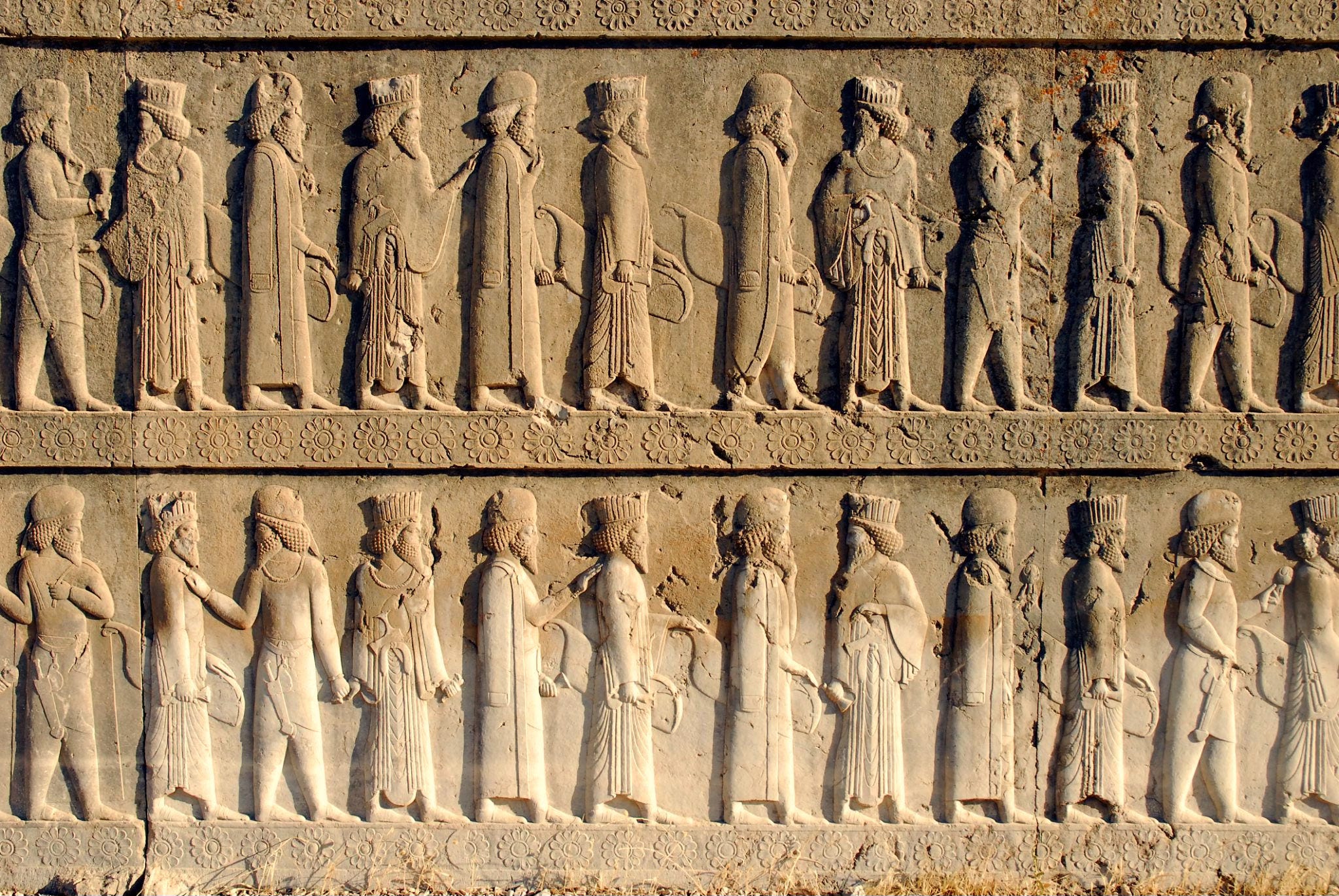
Asha, Druj, and the Legibility of Political Form
In the Zarathushtrian philosophical framework, asha establishes a relation between truth and structure. It governs what may be known, how things are arranged, how they endure, and under what conditions their coherence becomes perceptible.⁴ A condition aligned with asha yields clarity in differentiation, stability in transmission, and a field of relations whose intelligibility can be sustained across time.
Druj enters at another level. Its work reaches beyond falsehood in the narrow sense. It distorts proportion; it disorders relation; it leaves surfaces standing while weakening the internal coherence that once held them in place. Under its pressure, forms remain visible yet cease to gather meaning with the same force. Distinctions blur, signals proliferate, and judgment becomes increasingly difficult to stabilise.⁵
Once transposed into the civic domain, this distinction yields a more exact account of political conditions, one capable of reaching beneath the standard vocabulary of repression, corruption, and authoritarianism. A polity aligned, however imperfectly, with asha exhibits structured authority, intelligible institutions, and a durable relation between law, action, and consequence. Authority appears there as something that can be recognised and evaluated because it operates within a discernible order.
A polity saturated by druj presents another configuration. Institutional boundaries weaken; parallel structures multiply; legal and administrative systems function through overlapping and often conflicting logics. Public discourse contracts into repetitive forms that circulate without clarifying anything. Distortion enters structure itself and reorganises it from within.⁶
The present governing structure in Iran exhibits this condition with increasing intensity. This condition does not define Iran as a civilisational formation; it characterises the formation that presently occupies it. Authority circulates across institutions whose relations remain opaque even to those subject to them, and legal frameworks coexist without coherence. The relation between decision and consequence becomes unstable, extending beyond repression into a deeper erosion of intelligibility within the political field.⁷
Xšaθra and the Structure of Authority
The concept of xšaθra—later preserved in forms such as shahr and shahrivar—permits a more exact account of political order. It names the structuring of authority in its proper form: the ordered exercise of power through which legitimacy emerges in alignment with asha, with order as intelligible form.⁸ Within this conception, authority cannot be detached from form. Governance is judged by its capacity to maintain coherence across the field in which it acts, to sustain legibility, and to preserve a horizon within which power can be recognised as ordered rather than merely endured.
Iranian historical experience supplies repeated articulations of this principle across more than a millennium of continuous imperial formations. The Achaemenid Empire, conventionally dated from the mid-sixth century BCE to Alexander’s conquest in 330 BCE, governed a territorial expanse stretching from the Indus Valley to the eastern Mediterranean through an administrative architecture whose scale still requires emphasis whenever one speaks casually of “ancient Persia”: satrapal government, royal roads, tax districts, inscriptional multilingualism, regionally differentiated law and custom held within an imperial frame of remarkable scope. Difference remained present, at times sharply so, yet it entered an order within which it could be rendered administratively legible.⁹
After the Macedonian destruction of Achaemenid sovereignty and the establishment of Seleucid rule over Iran, a Hellenistic dynastic state took hold across much of the former imperial field. The Seleucid Empire grew out of the partition of Alexander’s conquests after 323 BCE and retained Iran under a political formation whose centre lay elsewhere and whose relation to Iranian elites remained structurally unstable. By the mid-second century BCE, the Seleucids were losing their Iranian possessions, and the Arsacids drove them out of Iran and eventually from Mesopotamia as well. The Ashkānian recovery marks a restoration of sovereignty from within the Iranian field itself. An Iranian dynasty reasserts control over a land held in the interval by a Hellenistic successor state, and with that reassertion restores the conditions under which authority can once again be articulated in its own terms.¹⁰
The Arsacid (Ashkānian/Parthian) Empire, from roughly 247 BCE to 224 CE, sustains this trajectory through a distinct structural logic. Authority operates through a distributed configuration of power, combining central kingship with regional autonomy, major noble lineages, and subordinate rulers across an extended territorial field. Historical sources also attest an aristocratic assembly whose role in matters of succession and governance indicates that imperial coherence was not produced through unilateral command alone, but through structured participation among elite strata of the polity. One encounters here a decentralised sovereignty whose cohesion arises through negotiated alignment across differentiated centres of authority, without recourse to uniform control.¹¹
The Sasanian Empire, from 224 to 651 CE, gathers that field into a more concentrated articulation. Legal, fiscal, and institutional structures are consolidated within a more explicitly unified horizon of order and hierarchy. Ardashir I emerges from Persis, defeats the last Arsacid ruler, and founds a new Iranian empire from within the fractured field of late Parthian sovereignty. Dynastic change becomes, in this moment, something more exacting: a rearticulation of Iranian statehood from within its own historical ground, oriented toward a renewed claim to Ērānšahr as an ordered domain of rule. The Sasanian state then endures for more than four centuries while contending with Rome and Byzantium as an imperial equal.¹²
Across these formations, persistence outweighs repetition. Authority appears again and again as something that must be structured, articulated, and sustained within an intelligible order. Once one follows the longer Iranian arc, continuity emerges here as endurance through rupture and recovery, a historical coherence secured across repeated acts of reconstitution. The collapse of Achaemenid sovereignty under Alexander was followed by Seleucid occupation and then by Arsacid recovery. The Arab-Muslim conquest in the seventh century introduced a transformation whose consequences have extended across more than a millennium and remain active even now in significant respects, not as a property of any contemporary people or belief, but as a set of historical transformations in language, governance, and cultural transmission; yet Iranian language, memory, forms of courtly and administrative life, and the cultural grammar of sovereignty were not extinguished. They were reworked, translated, reinscribed, and repeatedly reappropriated by Iranians themselves in dynastic formations—most notably under the Samanids—as well as in literary, territorial, and institutional forms. Mongol devastation in the thirteenth century introduced another violent fracture, yet Iran again re-entered history not as residue but as reconstituted order. Much later, the Qajar period left behind a polity weakened by fragmentation, concession, administrative frailty, and geopolitical exposure; from those ruins the Pahlavi state undertook the building of modern Iran through bureaucratic centralisation, infrastructural integration, military consolidation, educational reform, and juridical restructuring. Each sequence carries its own density and its own irreducible historical grain. I am not collapsing them into one another; I am saying that Iranians know, from within their own history, that rupture does not conclude history. The memory of governance in Iran therefore includes the repeated capacity to reconstruct intelligibility under altered conditions.¹³
Within this framework, the figure of the Shah arises from a conceptual field other than the European category of ‘king,’ and carries a different structure of legitimacy. The term derives from Old Iranian xšāyaθiya, the one who exercises xšaθra, whose position becomes intelligible only within the field of structured authority rather than as an isolated instance of personal rule. Its later Persian forms preserve that semantic orientation even where historical usage shifts. The figure thereby designates a positional function within an ordered whole, one that presupposes alignment with intelligibility as the condition of legitimacy.¹⁴
The continuity of this conceptual field is inscribed not only in the titles through which authority is articulated, but in the name of the polity itself, whose historical depth extends across successive linguistic and political formations. The term Iran preserves, in its contemporary form, the Old Iranian aryānām; the Avestan tradition preserves related forms such as airyānąm vaējō, conventionally understood as denoting the expanse or domain of the Aryans; Middle Persian later gives us Ērān and Ērānšahr, the latter appearing in Sasanian inscriptions, including those of Ardashir I and Shapur I, to designate a territorially and politically ordered domain conceived as the land of the Aryans. The persistence of this designation across centuries remains visible not only in inscriptional and administrative materials but in literary and historical memory, most notably in Ferdowsi’s epic Shāhnāmeh, where Īrān names the political and civilisational horizon within which sovereignty, conflict, kinship, and order are narrated across an extended temporal field. Alongside this enduring self-designation, the term “Persia,” derived from Greek Persis—originally designating the region of Parsa/Pars associated with the Achaemenid ruling centre—enters external languages as a geographically specific term that expands within Greek historiography to signify the imperial formation as a whole, and is later generalised in European usage to denote the country in its entirety. One confronts here two trajectories of naming: one internal, continuous, and conceptually anchored; the other external, episodic, and shaped by conditions of encounter. The distinction opens onto a question of historical scale, within which ‘Iran’ names a civilisational continuity extending across millennia rather than a recent political designation.¹⁵
The conceptual continuity traced through the name Iran returns, at this point, to the figure in whom that continuity is historically enacted. The title shāh acquires its weight within the historical memory sedimented in its own usage, where its meaning persists across successive formations of authority as the site at which civilisational continuity is assumed, rearticulated, and made operative. From Cyrus the Great—known in Persian historical memory as Kūrosh-e Bozorg, šāhanšāh-e Irān—whose imperial articulation, preserved in the Cyrus Cylinder and in wider Achaemenid state practice, came to be associated, both in modern Iranian political memory and in broader global reception, with plurality, restoration, and lawful sovereignty, and later reinterpreted as a precursor to what is now described as human rights; to Darius the Great, whose inscriptions at Behistun articulate rule in relation to truth, order, and the maintenance of a differentiated yet unified realm; through Ardashir I, founder of the Sasanian state, and Shapur I, who asserted Iranian sovereignty in direct confrontation with Rome; to Shapur II and Khosrow I, under whom imperial administration, law, and intellectual life reached a striking degree of consolidation in the later Sasanian period; the title marks a recurrent form of authority embedded within a long civilisational horizon. That continuity extends into the early modern and modern periods in altered but recognisable configurations: Nāder Shah’s eighteenth-century reassertion of territorial sovereignty after fragmentation; Reza Shah Pahlavi, who in the early twentieth century established a centralised modern state through administrative consolidation, infrastructural integration, and institutional reorganisation; and Mohammad Reza Shah Pahlavi, upon whom the title Āryāmehr (“Light of the Aryans”) was conferred, a designation resonant with older Iranian conceptions of aryānām, and whose programme of reform, including the White Revolution, pursued rapid modernisation, secular state formation, and economic expansion within a twentieth-century global frame. Each emerges under distinct historical conditions, yet all remain legible within a shared conceptual field in which shāh designates a figure situated within the longer Iranian question of how authority is formed, stabilised, and rendered intelligible across successive reconfigurations of order.¹⁶
The persistent misreading of this distinction has contributed to systematic misunderstandings of Iranian political history, where categories derived from European political vocabulary are imposed upon formations organised by another conceptual grammar. The issue gathers there, and it remains with us.
Civic Entropy and Structural Dislocation
The present governing formation in Iran may be described, with some precision, as a condition of high civic entropy. By this I mean a degradation of relational order within an existing state structure, under which institutions continue to function, offices remain occupied, laws continue to proliferate, and public rituals of authority are incessantly reproduced, while the internal coordination that would render these elements intelligible as parts of a coherent political order steadily erodes. Under such conditions, circulation thickens across the field—more organs, more commands, more procedural layers, more surveillance, more declarations, more slogans, more punitive measures—while clarity recedes from the relations that ought to bind decision to consequence, law to enforcement, centre to periphery, claim to effect.¹⁷
This degradation appears in the overlapping of jurisdictions, in the multiplication of parallel chains of authority, in the routine coexistence of formal legality with discretionary coercion, and in the widening interval between the visible architecture of the state and the actual routes through which power moves. A polity may retain the exterior signs of order while its internal grammar has become unstable. Ministries, courts, security bodies, elected offices, unelected offices, clerical organs, military-economic formations, and supervisory councils continue to operate, yet the hierarchy that would bind them into a consistently intelligible structure becomes increasingly difficult to stabilise even analytically, let alone civically. The public field grows saturated with force and procedure while becoming thinner in legibility.¹⁸
Under such pressure, discourse itself begins to bear the mark of distortion. Official language—circulating through state media, institutional pronouncement, and ideological repetition—repeats moral formulas whose semantic force has long since been hollowed by overuse; oppositional language, by contrast, often moves through accelerated circuits in which urgency sharpens visibility while fragmenting continuity. Words remain active, at times feverishly so, while their relation to durable institutional transformation becomes harder to hold in view. The problem lies at a deeper stratum than policy failure. It reaches the level at which political order becomes sayable, knowable, and structurally graspable as an order at all.
For that reason, the question before Iran reaches beneath reform in the narrow administrative sense, toward the deeper problem of political form itself. What presses upon the present, then, is rearticulation at the level of form, the recovery of a principle of arrangement through which authority, law, and civic life may again become mutually intelligible.
Society, Resistance, and Continuity Under Pressure
Against this prolonged dislocation, Iranian society has sustained a field of resistance whose significance lies precisely in its continuity. The field of resistance unfolds across a far wider range than episodic protest alone. One sees it in recurrent mobilisations that have crossed cities, provinces, classes, and generations; in labour actions and teachers’ protests; in student organisation; in women’s refusal of compulsory veiling; in intellectual and artistic production inside and outside the country; in diasporic argument; and in countless smaller acts of non-compliance through which daily life withdraws consent from the ideological grammar imposed upon it. These forms move through dispersion, heterogeneity, and unequal tempo. Their importance lies elsewhere: together they preserve a social capacity for judgment under conditions designed to exhaust judgment itself.¹⁹
The decisive feature here is continuity of civic orientation, with courage as its most visible expression. Iranian society has not entered a condition of passive suspension awaiting the restoration of order from above. It has instead kept pressure on the site at which order must be thought again, by refusing the equivalence that the governing structure seeks to impose between state, nation, religion, and society. That refusal has become one of the decisive facts of the present. Quietly, and therefore with greater consequence, it preserves the distinction on which this essay depends: the distinction between Iran as a long civilisational and social continuity, and the present ruling formation as a historically contingent regime whose orientation has been structurally misaligned with that continuity, and at points openly antagonistic toward the cultural and social forms through which it persists.²⁰
Recent protest cycles have made this distinction visible even to observers previously inclined to read Iran exclusively through the vocabulary of state power. Their slogans, symbols, songs, gestures, and dispersed forms of coordination indicate demands whose horizon extends well beyond immediate grievance. What appears there is a struggle over the conditions of political legibility itself: who speaks for the country, under what language of authority, and in relation to what image of collective life. The response of the governing structure, with its recourse to surveillance, imprisonment, forced confession, execution, and documented abuses in custody, including sexual violence in detention, alongside the repeated use of lethal force, including live fire against unarmed civilians in the streets, has clarified the matter further.²¹
Yet the external reception of these events often breaks their continuity. What is lived internally as a sustained historical process becomes, once filtered through foreign media cycles and policy discourse, a sequence of disconnected moments: a protest wave, a crackdown, a diplomatic crisis, a nuclear dispute, a succession event, a regional escalation, or an economic crisis attributed primarily to sanctions, through which the longer continuity of social demands and the structural incompatibility of the governing formation with Iran fall out of view. The fragmentation is consequential. It contracts the horizon within which resistance in Iran can be understood, and with it the deeper question that this accumulation keeps pressing back into view.
External Misrecognition and the Compression of Iran
A recurrent failure in external interpretations of Iran begins with compression of scale. Historical depth is shortened, institutional memory is flattened, civilisational continuity is set aside, and the country is inserted into analogical frames assembled elsewhere and for other cases. One then hears Iran discussed through the exhausted comparison with Iraq, Afghanistan, or any other state or territory whose modern formation proceeded under sharply different imperial, colonial, and geopolitical conditions. Such analogies circulate easily because they are efficient. They yield quick intelligibility for outsiders. They also generate distortion.²²
Iran enters modernity with a far longer and denser archive of statehood than such comparisons usually allow. The issue concerns analytical proportion, historical scale, and the adequacy of the conceptual frame brought to Iran. A polity whose historical memory includes Achaemenid satrapal administration, Arsacid elite-mediated sovereignty, Sasanian juridical and territorial consolidation, post-conquest reconstitution of Iranian forms of political and cultural life under Samanid and other Iranian dynasties, Safavid and post-Safavid reorganisation, constitutional rearticulation in the modern juridical sense, and twentieth-century bureaucratic modernisation cannot be read adequately through models designed for states whose contemporary institutional forms emerged under markedly different sequences of partition, occupation, or externally managed reconstruction.²³
The problem begins at the level of framing, before any single comparison has even been chosen. Analogy itself begins, at that point, to substitute for history. Once that substitution occurs, the present regime is taken either as the exhaustive truth of Iran, with several decades of ideological rule improperly made to stand in for a civilisational formation extending across millennia, or as the inaugurating break of a supposedly new political order detached from that continuity altogether. The reduction then generates a second confusion, whereby the possible end of the current formation is imagined only through scenarios drawn from foreign interventions elsewhere, as though Iran possessed no indigenous reservoirs of social organisation, administrative memory, political language, and historical self-understanding from which another order might be assembled.²⁴
At this point the interpretive error ceases to be merely analytical and begins to acquire political consequence. Compressed history produces compressed expectation. Iran is imagined either as permanently trapped in theological authoritarianism or as destined, after any rupture, for formless breakdown. Both expectations derive from the same prior mistake: the failure to grasp the scale of the Iranian historical field and the repeated manner in which order, after severe disruption, has been reconstituted within it.
Intervention, Recalibration, and Historical Trajectory
The question of intervention enters the argument at precisely this point, and here too scale matters. The case of Iran requires a different frame of interpretation, one capable of registering the force of sanctions, strategic confrontation, regional war, and external pressure as they act upon an internally differentiated field, without collapsing the analysis into foreign templates. These pressures unfold in interaction with a society already under strain, with a regime already suffering loss of legitimacy, and with a historical structure whose capacities for reorganisation are older and more substantial than outside observers often grant.²⁵
The present situation is therefore better understood as a recalibrating convergence of pressures. Internal resistance continues; the governing structure hardens and distorts itself further in order to survive; regional confrontation intensifies the costs of ideological expansionism; the difference between state coercion and social legitimacy grows harder to conceal. Under such conditions, transformation comes into view as the emergence of a new configuration from a field already in motion, shaped by internal resistance, regime hardening, and shifting regional pressures. The language of “regime change” often obscures this because it suggests a single event. The removal of the present regime is a necessary condition, and what follows, if one traces the longer arc, concerns the rearticulation of political order: the formation of a new configuration of authority shaped by internal resistance, organised opposition, and the reactivation of historical capacities of governance. That has happened before, under different names, after different ruptures, through different agents, but with a recurring structural logic.²⁶
Historical precedent matters here because it disciplines both panic and fantasy. Iran, understood as a civilisational continuity, has already passed through imperial overthrow, dynastic collapse, conquest, periods of weakened central authority, foreign pressure, and internal decay without ceasing to generate new political forms. The Arab-Muslim conquest, despite powerful processes of linguistic and cultural displacement, did not erase Iranian language or memory. Mongol devastation, for all its violence and destructiveness, did not terminate Iranian history. The late Qajar state, weakened by concession, administrative erosion, and geopolitical subordination, was followed by a twentieth-century project of state-building under the Pahlavi dynasty that restored administrative coherence, territorial integration, and institutional continuity at scale. The task here is not the recovery of any single historical formation, but the restoration of historical proportion within a civilisational continuum extending across millennia. Reconstitution is a defining principle of the Iranian historical archive, repeatedly shaping continuity across episodes of rupture.²⁷
This is also why the temporal logic of Nowruz becomes directly relevant to the political argument. Renewal, in the Iranian imagination, does not arrive as instantaneous miracle. It unfolds through sequence: preparation, purification, ordering, gathering, and release. The wider cycle of the New Year, from Chahārshanbe Suri, with its rites of fire and symbolic casting-off, through the equinoctial threshold of Nowruz itself to the release enacted in Sizdah Bedar, stages transition as process rather than event. Weakness, illness, and misfortune are cast off; vitality is taken on; the household arranges in miniature a world ordered again; the threshold is crossed; the renewed year opens; what has been gathered is finally released back into the wider field of life. Any rearticulation of political order is likely to follow a comparably sequential logic, less as a single event than as a field passing, stage by stage, from distortion toward restored legibility.
Nowruz and the Return of Order
Nowruz gives this argument its temporal form. It marks the vernal equinox; it names the renewal of the year through an astronomical threshold; and it has endured across pre-Islamic, Islamic, early modern, and modern Iranian formations with a continuity that no single regime has been able to contain.²⁸ Recurrence names only the outer form of its significance. The cycle that surrounds it matters as much as the day itself: preparation, fire, cleansing, domestic arrangement, visitation, release into nature. Renewal appears here as an ordered sequence through which a world is symbolically purified, gathered, and begun again.
The pre-Nowruz fire rite, preserved in Chahārshanbe Suri, condenses this logic into a single gesture. In the familiar formula zardī-ye man az to, sorkhī-ye to az man, weakness, pallor, depletion, and affliction are cast off, while warmth, radiance, and vitality are taken on. Within a Zarathushtrian conceptual horizon, this may be read as a ritual prefiguration of the passage from distortion toward order. The household, too, enters the sequence. The Haft Sīn stages order materially and domestically, each home assembling in miniature a world gathered, arranged, and made legible again.²⁹
This is why Nowruz has remained so potent across Iranian history. It gathers renewal and fracture within the same temporal horizon. Political orders have risen, fractured, and disappeared. Dynasties have been founded and overthrown. Conquests have interrupted institutional life. Yet Nowruz returns with a precision that does not ask permission from any regime. In Persian historical memory, the figure of Jamshid remains attached to this return as an emblem of royal radiance, worldly order, and the proximity between splendour and fall. The festival thereby preserves a historical awareness that renewal is neither automatic nor innocent, but emerges through the reconstitution of order after disruption.³⁰
Within this horizon, the present governing structure appears as what it is: historically consequential and often destructive, yet not civilisationally exhaustive. Beneath it, around it, and against it, older layers of memory, social organisation, ethical orientation, and political expectation remain active. Iran has carried these layers through conquest, devastation, imposed translation, and ideological capture before. It carries them still.
For many Iranians, the present is experienced as a harsh transition whose end has not yet taken institutional shape. That sensibility is historical in its formation. It arises from recognition: from the repeated experience that moments of rupture in Iran have not been granted the final word, and have been followed by renewed articulation of order.
Nowruz names that recognition in temporal form. It returns at the point where the year turns, and with it returns a civilisational memory extending across millennia, irreducible to the temporal limits of any present state or ruling formation. In that memory, order gathers alignment, legibility, renewal, and the recovery of proportion after distortion. What returns here is Iran’s capacity to articulate political form once again in terms adequate to its own history.³¹
References
¹ Mary Boyce, Zoroastrians: Their Religious Beliefs and Practices (London: Routledge & Kegan Paul, 1979), pp. 1–27; Mary Boyce, ‘Nowruz i. In the Pre-Islamic Period’, Encyclopaedia Iranica, 2000; Mary Boyce, ‘Festivals i. Zoroastrian’, Encyclopaedia Iranica, 1999.
² Boyce, Zoroastrians, pp. 1–27; Boyce, ‘Festivals i. Zoroastrian’; Kasheff, Manouchehr, and Saʿīdī Sīrjānī, ʿAlī-Akbar, ‘Čahāršanba Sūrī’, Encyclopaedia Iranica, 1990.
³ Jean Kellens, Essays on Zarathustra and Zoroastrianism, trans. and ed. by Prods Oktor Skjærvø (Costa Mesa, CA: Mazda, 2000), pp. 1–28; Gherardo Gnoli, Zoroaster’s Time and Homeland: A Study on the Origins of Mazdeism and Related Problems (Naples: Istituto Universitario Orientale, 1980).
⁴ Bernfried Schlerath and Prods Oktor Skjærvø, ‘Aša’, Encyclopaedia Iranica, 1987; Helmut Humbach, The Gāthās of Zarathushtra and the Other Old Avestan Texts, 2 vols (Heidelberg: Carl Winter, 1991), I, pp. 123–27.
⁵ Kellens, Essays on Zarathustra and Zoroastrianism, pp. 35–52; Humbach, The Gāthās of Zarathushtra and the Other Old Avestan Texts, I, pp. 119–27.
⁶ Niklas Luhmann, Social Systems, trans. by John Bednarz, Jr and Dirk Baecker (Stanford, CA: Stanford University Press, 1995), pp. 136–72; Arjun Appadurai, Modernity at Large: Cultural Dimensions of Globalization (Minneapolis: University of Minnesota Press, 1996), pp. 27–47.
⁷ Kazem Alamdari, ‘The Power Structure of the Islamic Republic of Iran: Transition from Populism to Clientelism and Militarization of the Government’, Third World Quarterly, 26.8 (2005), 1285–1301.
⁸ William W. Malandra, ‘Šahrewar’, Encyclopaedia Iranica, 2000; Émile Benveniste, Indo-European Language and Society, trans. by Elizabeth Palmer (London: Faber & Faber, 1973), pp. 305–11.
⁹ Pierre Briant, From Cyrus to Alexander: A History of the Persian Empire, trans. by Peter T. Daniels (Winona Lake, IN: Eisenbrauns, 2002), pp. 357–420; Amélie Kuhrt, The Persian Empire: A Corpus of Sources from the Achaemenid Period, 2 vols (London: Routledge, 2007), II, pp. 695–720.
¹⁰ The Cambridge History of Iran, III.1: The Seleucid, Parthian and Sasanian Periods, ed. by Ehsan Yarshater (Cambridge: Cambridge University Press, 1983), pp. 3–92; Rolf Strootman, ‘Seleucid Empire’, Encyclopaedia Iranica, 2015; Gherardo Gnoli, The Idea of Iran: An Essay on Its Origin (Rome: Istituto Italiano per il Medio ed Estremo Oriente, 1989), pp. 51–72.
¹¹ Josef Wiesehöfer, Ancient Persia from 550 BC to 650 AD, trans. by Azizeh Azodi (London: I.B. Tauris, 1996), pp. 157–98; Vesta Sarkhosh Curtis and Sarah Stewart, eds, The Age of the Parthians (London: I.B. Tauris, 2007), pp. 1–23, 69–92.
¹² Richard N. Frye, The History of Ancient Iran (Munich: C. H. Beck, 1984), pp. 287–342; Richard N. Frye, ‘The Political History of Iran under the Sasanians’, in The Cambridge History of Iran, III.1: The Seleucid, Parthian and Sasanian Periods, ed. by Ehsan Yarshater (Cambridge: Cambridge University Press, 1983), pp. 116–80; Parvaneh Pourshariati, Decline and Fall of the Sasanian Empire (London: I.B. Tauris, 2008), pp. 1–35.
¹³ Cyrus Ghani, Iran and the Rise of Reza Shah: From Qajar Collapse to Pahlavi Power (London: I.B. Tauris, 1998); Ehsan Yarshater, ‘Iran ii. Iranian History (2) Islamic period (pp. 5-6).’, Encyclopaedia Iranica, 2004.
¹⁴ Roland G. Kent, Old Persian: Grammar, Texts, Lexicon (New Haven, CT: American Oriental Society, 1953), pp. 176–77.
¹⁵ Gnoli, The Idea of Iran, pp. 1–46; David Neil MacKenzie, ‘Ērān-Wēz’, Encyclopaedia Iranica, 1998; Firdawsī, Shāhnāmeh, ed. by Djalal Khaleghi-Motlagh, 8 vols (New York: Bibliotheca Persica, 1987–2008).
¹⁶ Briant, From Cyrus to Alexander, pp. 40–56, 117–38; Kuhrt, The Persian Empire, I, pp. 69–72.
¹⁷ Luhmann, Social Systems, pp. 136–72; Appadurai, Modernity at Large, pp. 27–47.
¹⁸ Alamdari, ‘The Power Structure of the Islamic Republic of Iran’, pp. 1285–1301.
¹⁹ Nahid Siamdoust, ‘Women Reclaiming Their Voices for Life and Freedom: Music and the 2022 Uprising in Iran’, Iranian Studies, 56.3 (2023), 577–83.
²⁰ Ladan Boroumand, ‘The Islamic Republic’s War on Iranians’, Journal of Democracy, 36.3 (2025), 169–83.
²¹ Amnesty International, Iran: Details of 321 Deaths in Crackdown on November 2019 Protests (London: Amnesty International, 2022); United Nations Human Rights Council, Detailed Findings of the Independent International Fact-Finding Mission on the Islamic Republic of Iran, A/HRC/61/CRP.2 (13 March 2026); Human Rights Watch, World Report 2024: Iran (New York: Human Rights Watch, 2024), section on Iran; Amnesty International, “They violently raped me”: Sexual violence weaponized to crush Iran’s “Woman Life Freedom” uprising (London: Amnesty International, 2023).
²² Samuel P. Huntington, Political Order in Changing Societies (New Haven, CT: Yale University Press, 1968), pp. 1–92; Charles Tilly, Coercion, Capital, and European States, AD 990–1990 (Cambridge (Mass.): Blackwell, 1990), pp. 1–32.
²³ Briant, From Cyrus to Alexander, pp. 357–420; Wiesehöfer, Ancient Persia from 550 BC to 650 AD, pp. 157–98; Maria Brosius, The Persians: An Introduction (London: Routledge, 2006), pp. 1–18, 91–108.
²⁴ Gnoli, The Idea of Iran, pp. 1–46; Ghani, Iran and the Rise of Reza Shah.
²⁵ Alamdari, ‘The Power Structure of the Islamic Republic of Iran’, pp. 1285–1301; Boroumand, ‘The Islamic Republic’s War on Iranians’, pp. 169–83.
²⁶ Ghani, Iran and the Rise of Reza Shah; Gnoli, The Idea of Iran, pp. 1–46.
²⁷ Ghani, Iran and the Rise of Reza Shah; Yarshater, ‘Iran ii. Iranian History (2) Islamic period (pp. 5-6).’.
²⁸ Boyce, Zoroastrians, pp. 1–27; Boyce, ‘Nowruz i. In the Pre-Islamic Period’; Boyce, ‘Festivals i. Zoroastrian’.
²⁹ Boyce, Zoroastrians, pp. 1–27; A. Shapur Shahbazi, ‘Haft Sīn’, Encyclopaedia Iranica, 2002.
³⁰ Boyce, Zoroastrians, pp. 1–27; Firdawsī, Shāhnāmeh, I; Gnoli, The Idea of Iran, pp. 1–46.
³¹ Gnoli, The Idea of Iran, pp. 1–46; Firdawsī, Shāhnāmeh, I.